A warehouse floor that cracks within a year. A pipeline coating that blisters after one monsoon. A chemical plant slab that dissolves where acid has pooled. Failures like these rarely trace back to “bad epoxy.” They trace back to the wrong system, the wrong cure, or a mismatch between the chemistry and the environment.
That is why epoxy for construction deserves a more careful look than it usually gets. Epoxy is no longer just a flooring material. It sits in structural repair, corrosion protection, bonding, composites and electrical insulation, and in each of these the performance comes down to how the resin is cured.
What Is Epoxy Resin, and Why Does Construction Depend on It?
Epoxy resin is a thermosetting polymer that cures into a hard, chemically resistant, strongly adhesive solid when it reacts with a curing agent. That reaction, called crosslinking, builds a dense three-dimensional network, and this network gives epoxy its adhesion to concrete and steel, its resistance to chemicals and abrasion, and its dimensional stability.
Construction depends on it because few other materials combine bond strength, durability and low shrinkage in one system. Cement-based products are strong in compression but porous. Many coatings protect a surface but do not bond structurally. Epoxy does both jobs, which is why specifiers keep returning to it for demanding substrates.
Where Is Epoxy Used in Industry Today?
The honest answer is “in more places than most buyers assume.” Here are the applications we see most often.
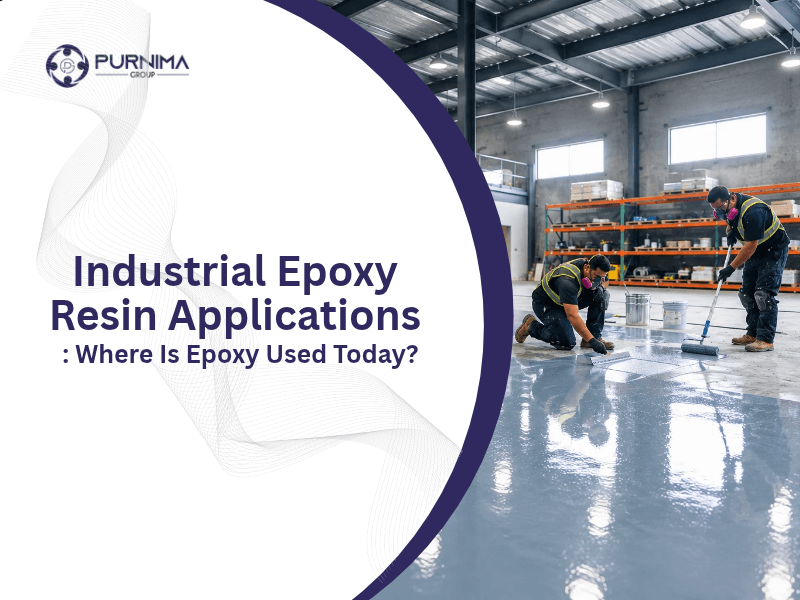
Industrial and warehouse flooring. Self-levelling and broadcast systems handle forklift traffic, thermal cycling and chemical spills. Pharma, food processing and automotive plants specify them for hygiene and cleanability as much as for strength.
Protective coatings for steel and concrete. Epoxy primers and mid-coats are standard in tanks, pipelines, bridges and marine structures. Their job is simple to state and hard to execute: keep water, salts and oxygen away from the substrate.
Structural repair and bonding. Crack injection, anchor grouting, and bonding of new concrete to old all rely on epoxy’s adhesion and low shrinkage. Here, pot life and cure behavior on site matter as much as ultimate strength.
Composites and wind and infrastructure components. Epoxy matrices hold fibre reinforcement together in everything from pultruded profiles to blade structures.
Electrical and electronics. Potting compounds, encapsulants and laminates use epoxy for insulation and thermal stability.
Notice what these have in common. The resin is rarely the deciding variable. The curing system is.
The Curing Agent Decides the Outcome
An epoxy curing agent, also called an epoxy hardener, is the co-reactant that converts liquid resin into a solid network, and its chemistry determines cure speed, flexibility, chemical resistance and temperature tolerance. The same resin can behave very differently depending on the hardener paired with it.
Experienced applicators know this from the field. An aliphatic amine gives fast room-temperature cure but can blush in humid conditions. Aromatic systems offer strong chemical resistance but cure more slowly and often need warmth. Water-based curing agent compounds reduce solvent load and suit indoor or low-odour environments, with a trade-off in ultimate film properties that has to be understood up front.
Then there is the question every site engineer in a humid or cool climate eventually asks: what happens when the temperature drops or the surface is damp? This is where the phenalkamine curing agent earns its place. Phenalkamines, derived from cardanol (a cashew nut shell liquid component), cure at low temperatures and tolerate moisture better than many conventional amine hardeners. That makes a phenalkamine epoxy hardener a practical choice for marine, tank-lining and heavy-duty anti-corrosion work, where conditions are rarely ideal.
Bio-Based Epoxy Hardeners: Where Sustainability Meets Performance
Procurement teams are now asking about the carbon profile of coatings alongside pot life and price. A bio-based epoxy hardener is a curing agent made partly or wholly from renewable raw materials, such as plant-derived feedstocks, rather than purely petrochemical sources.
Cardanol-based chemistry is the clearest example. Because it comes from a by-product of the cashew industry, a phenalkamine resin curing agent can be both high-performing and renewable-derived. A sustainable epoxy hardener should still be judged on the same terms as any other: cure profile, chemical resistance, adhesion and consistency from batch to batch. “Bio-based” is a sourcing attribute, not a substitute for performance data. Any renewable curing agent worth specifying should come with technical data you can test against your own conditions.
Choosing Among Epoxy Curing Agents Manufacturers
Not all suppliers are equal, and the difference rarely shows in a datasheet. When evaluating epoxy curing agents manufacturers, look at four things.
First, technical depth. Can the supplier explain why a given hardener suits your substrate and climate, or do they only quote a price? Second, consistency. Amine value and viscosity should hold between batches, because variability shows up as inconsistent cure on your floor. Third, range. A curing agent manufacturer that offers aliphatic, aromatic, water-based and bio-derived options can recommend the right chemistry instead of the one they happen to stock. Fourth, support: formulation help, trial quantities and responsiveness when a site problem appears.
Why Local Sourcing Matters for Gujarat’s Industrial Belt
For projects across Gujarat, working with an epoxy manufacturer in Ahmedabad shortens lead times, simplifies technical support and makes batch-level troubleshooting practical. If a cure issue appears on a Tuesday, a conversation with the manufacturer on Wednesday is worth more than a ticket to a distant distributor.
This is also where an epoxy supplier in Ahmedabad that manufactures its own curing agents holds an advantage over one that only trades. A manufacturer can adjust a formulation for a specific application. A trader generally cannot. At Purnima Groups, this is the principle we build around: as an epoxy curing agents manufacturer in Ahmedabad, we treat the hardener as an engineered component of the system, not a commodity added at the end.
A Practical Checklist Before You Specify
Before finalising any epoxy system, confirm these points:
- Substrate type, moisture content and surface preparation standard
- Service environment: chemicals, temperature range, UV exposure
- Application temperature and humidity on the day of work
- Required pot life, recoat window and time to service
- Whether a crosslinking agent change (aromatic, aliphatic, phenalkamine or water-based) fits the above
Five minutes on this list prevents most of the failures described at the start of this article.
Epoxy for Construction Rewards Specification Discipline
Epoxy for construction works when the chemistry is matched to the conditions, and it fails when it is not. The resin gets the attention, but the curing agent and the people who understand it decide whether a floor, coating or repair lasts. If you are specifying systems in Gujarat or evaluating epoxy curing agents manufacturers, bring the technical question first and the price second.
FAQ
Where is epoxy used in construction?
Epoxy is used in industrial flooring, protective coatings for steel and concrete, crack injection, anchor grouting and structural bonding. It is chosen where adhesion, chemical resistance and durability matter more than low upfront cost.
What does an epoxy curing agent do?
A curing agent reacts with epoxy resin to form a crosslinked solid. It controls cure speed, flexibility, chemical resistance and temperature performance, so the same resin can behave very differently with different hardeners.
What is a phenalkamine curing agent used for?
Phenalkamine hardeners are used for marine coatings, tank linings and heavy-duty anti-corrosion systems. They cure well at low temperatures and tolerate moisture better than many conventional amines.
Is a bio-based epoxy hardener as strong as a conventional one?
It can be, depending on the chemistry. Cardanol-derived hardeners perform well in demanding coatings, but any bio-based curing agent should be validated against your required cure profile and chemical exposure.
How do I choose an epoxy curing agent manufacturer?
Look for technical support, batch-to-batch consistency, a broad product range and the ability to adapt a formulation to your application. A manufacturer can tune a hardener for you, whereas a trader typically cannot.
Is there an epoxy manufacturer in Ahmedabad that makes its own curing agents?
Yes. Purnima Groups is an epoxy curing agents manufacturer in Ahmedabad, offering technical guidance and locally supported supply for projects across Gujarat.